

Animal By-Products in Dog Food: What They Really Mean

You are standing in the shop, you turn the pack around, read “meat and animal by-products” — and you are none the wiser. What is actually in there? Muscle meat? Liver? Or leftovers you would rather not think about?
This is exactly where most owners feel misled: a cute dog and the word “premium” on the front — and suddenly fog on the back. Worst of all: that fog is intentional.
But as soon as you understand a few simple terms, the game flips. Then you can read any label in 30 seconds and know immediately whether a food delivers what the front promises. That is exactly what you will learn here — step by step, no jargon.
Let us start with the term that misleads the most people.
What does “animal by-products” actually mean?
Put simply: everything from the slaughtered animal except the pure muscle meat. That includes organs and offal such as liver, heart, lungs, tripe, kidneys, or stomach.
And now the most important sentence of this whole article: the term alone says NOTHING about quality. Some by-products are high-quality, nutrient-rich offal; others are low-grade slaughter leftovers. Both are allowed to be called “animal by-products”.
So the real problem is not the category itself — it is that it usually is not broken down. If the label only says “animal by-products” with no further detail, you do not know whether you are feeding high-quality liver or ground-up leftovers. You have to trust blindly. And that is exactly what we want to change.
Open vs. closed declaration — the most important difference
There are two ways manufacturers can state their ingredients. Once you know this difference, you have already mastered half the label check.
An open declaration names every ingredient individually and with a percentage — for example “31% duck breast, 29% chicken breast, 12% liver”. You see exactly what is in it and how much.
A closed (vague) declaration lumps everything together under umbrella terms: “meat and animal by-products”, “cereals”, “vegetable by-products”. It sounds harmless, but it means you can judge neither quality nor quantity.
The rule of thumb is beautifully simple: the more open the declaration, the better you can decide. Pretty pictures and “premium” on the front do not count — what counts is what is written on the back.
High-quality vs. low-quality by-products
So you can classify things instantly while reading, here is the rough distinction — knowledge no packaging design will sell you.
- High-quality (valuable offal): liver, heart, lungs, tripe, kidneys, stomach. These organs provide nutrients that pure muscle meat does not contain in the same way.
- Low-quality (slaughter leftovers): feathers, claws, horns, beaks, hides. They provide barely any usable nutritional value and do not belong in good food.
Do you see now why the breakdown is everything? “Animal by-products” can mean liver — or feathers. Only when the label names what is inside (e.g. “12% liver, 8% heart”) can you truly judge quality.
Meat, meat meal, fresh meat — why a percentage is not just a percentage
Now it gets interesting — and even experienced owners fall into this trap. Many look for the highest meat percentage and think: the more percent, the better. But it is not that simple.
The reason: fresh meat consists largely of water, often around 70%. A claim like “70% fresh meat” sounds enormous, but part of it “cooks away” during processing. Dried meat or meat meal, on the other hand, is concentrated (water already removed), which is why a lower percentage here can mean more actual protein.
What does that mean for you? Do not be dazzled by a single big number. What matters more is the overall picture: which types of meat, in which form (fresh, dried, meal), in what traceable share — and without unnecessary fillers. Transparency beats a pretty marketing number.
Understanding the analytical constituents (crude protein, crude fat, crude fibre, crude ash, moisture)
Alongside the ingredient list, every pack shows the “analytical constituents”. These are mandatory declarations in percent. It sounds like chemistry, but it is explained in five minutes — and afterwards you will read them like a pro.
Two practical notes. First: because of the different moisture content, you cannot compare wet and dry food 1:1 using these numbers (dry food looks “higher in protein” because it lacks water). Second: “crude ash” scares many people unnecessarily — it is not dirt, just the mineral content. A moderate value is completely normal.
For orientation, a real example: for Canefelis “Pure Duck”, crude protein is ≥18%, crude fat ≥8%, and moisture ≤65%. Clear numbers you can work with directly.
Additives: useful or unnecessary?
“Additives” sounds suspicious at first — but it is not automatically bad. There are roughly two groups, and the difference matters.
Nutritional additives are, for example, vitamins and minerals. In a complete food they are actually necessary so the dog gets everything he needs. Technological additives serve shelf life, colour, or taste.
What to look out for: artificial flavours, artificial colours, and attractants — a good food does not really need them. Colours are only there for the human eye anyway; your dog does not care about colour. Attractants often mask the fact that the food offers little on its own. A food that manages without these tricks is usually the more honest one.
Complete food vs. complementary food — a small but important difference
This one term decides whether a food works as a main meal — and many people overlook it.
A complete food is composed so that it covers the daily requirements on its own. You can feed it permanently as the main meal. A complementary food covers only part of the requirements (e.g. pure meat without further nutrients) and is not sufficient as the sole meal in the long run.
The quick check: if the pack says “complete food” (Alleinfuttermittel), it is intended as a full meal. If it says “complementary food”, you need something alongside it. Both have their place — you just need to know what you are holding.
Grain, grain-free, and sugar — short and honest
Plenty of myths surround these topics, so let us keep it sober.
Grain is not inherently “evil”. It becomes a problem when cheap grain acts as an inexpensive filler making up most of the food and replacing costly meat. So look less at the word “grain-free” as a marketing stamp — and more at how high the meat content really is and what the main ingredients are.
Sugar, on the other hand, has no business in good dog food — it only serves to “prettify” colour and taste. If sugar (or caramel, syrup) appears in the ingredient list, that is a warning sign.
The order of ingredients — why it reveals everything
There is a trick that tells you a lot within three seconds, before you even read the percentages: the order of the ingredients.
Ingredients must be listed by weight, heaviest first. Whatever is at the top is what the food contains most of. If a type of meat comes first, that is a good sign. If grain or umbrella terms lead and meat only appears further down, it is clear what the food mainly consists of — no matter how “meaty” the front looks.
A little pro tip — “splitting”: sometimes one ingredient is divided into several smaller entries (e.g. “corn flour, corn gluten, corn starch”) so each item lands further down the list and meat visually moves up. Add such related items together, and you will see the true picture.
Two labels compared — a concrete example
Enough theory — let us make it practical. Imagine two cans side by side, both advertising “premium” and a happy dog on the front. Only on the back does the wheat separate from the chaff.
Food A is not necessarily “toxic”, but it leaves you in the dark. You do not know how much meat is inside, which offal, or why flavourings are needed. Food B answers every question by itself. And that is exactly the point: you do not need to become an expert. You just need to choose the can that has nothing to hide.
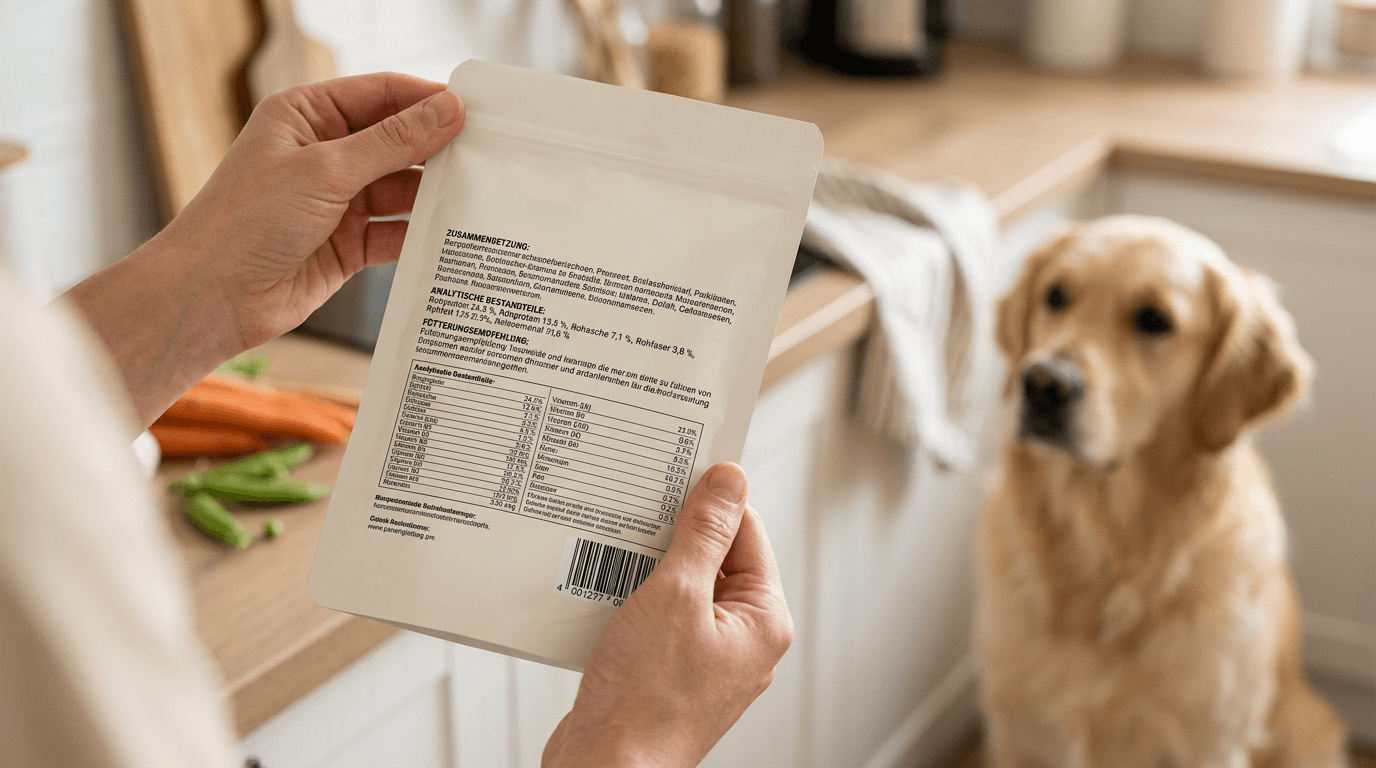
Turn the pack around: the 30-second label check
Now let us put it all together. You do not need to memorise anything — just pick up any pack on your next shopping trip, turn it around, and run through these five points:
- Specific animal species + percentage? (“31% duck breast” instead of just “meat”).
- By-products broken down? (“liver, heart” instead of just “animal by-products”).
- Meat content high and near the top of the list?
- No artificial flavours, colours, attractants — and no sugar?
- “Complete food” and analytical constituents clearly stated?
Five yeses? Then you are holding transparency instead of marketing. This one reflex — turn it around and read — protects you more reliably than any “premium” on the front.
Transparency instead of guesswork: the Canefelis example
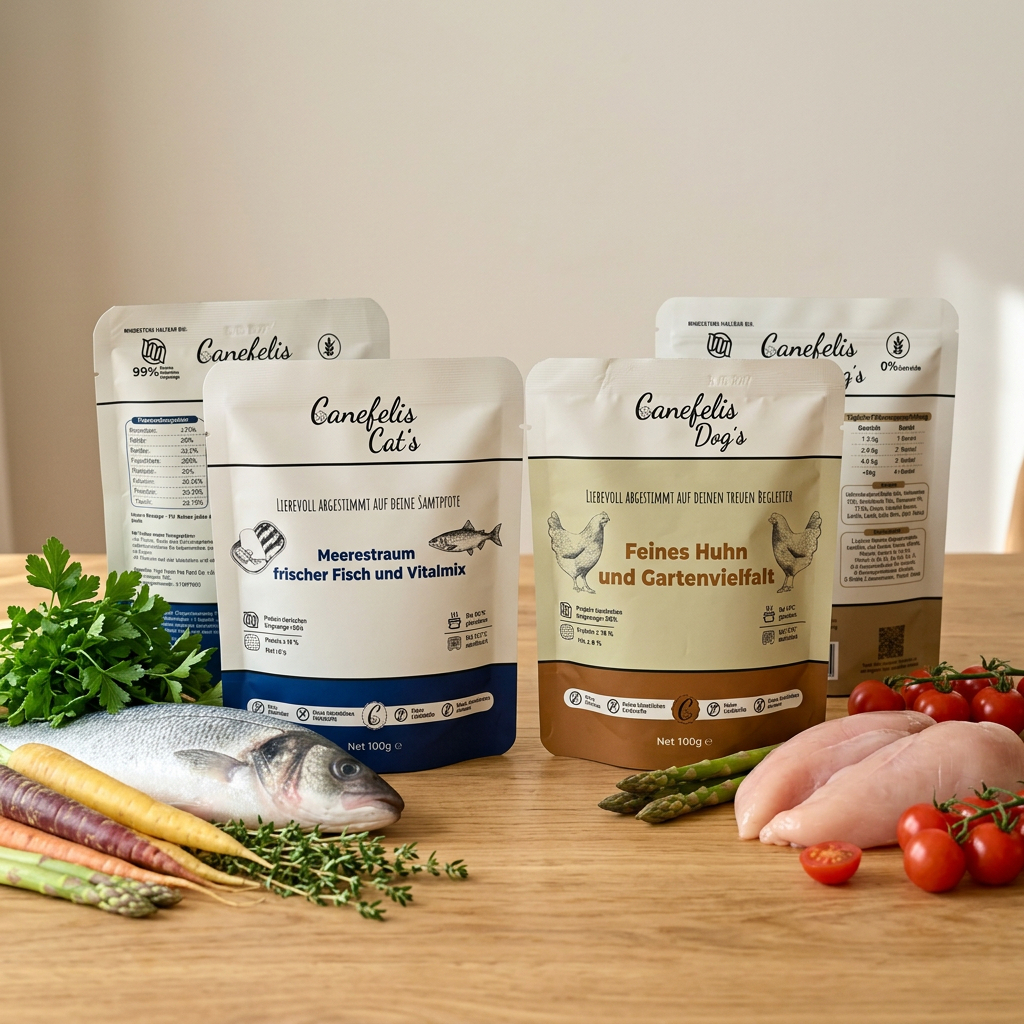
This is exactly the idea behind Canefelis: “What it says is what is inside.” No umbrella terms, no smoke screens.
With “Pure Duck” you see it in black and white: 31% duck breast, 29% chicken breast, 12% liver, and 8% heart — 80% meat and offal in total. Without artificial flavours, colours, or attractants, without sugar, gently cooked (soft-baked), and with an 18-month shelf life without refrigeration.
And you do not have to take our word for it. Do exactly what we recommended above: turn the pack around and read for yourself.
Frequently asked questions (FAQ)
Are animal by-products bad?
Not inherently. High-quality offal such as liver or heart are valuable ingredients. The real problem is the missing breakdown: if the label only says “animal by-products”, you do not know whether it is liver or slaughter leftovers.
How do I recognise a good declaration?
Specific ingredients with percentages, broken-down offal, a clear meat content, the label “complete food”, and no artificial flavours, colours, or sugar.
Why is a meat percentage not just a percentage?
Because fresh meat contains a lot of water (often ~70%). “70% fresh meat” and dried meat/meat meal are therefore not directly comparable. Look at the whole composition, not just one number.
What does “complete food” mean?
That the food covers the daily requirements on its own and can be fed as the main meal — unlike a “complementary food”, which only covers part of them.
Is grain-free food automatically better?
No. “Grain-free” is not a seal of quality. What matters is the meat content and whether cheap fillers (grain or otherwise) replace the meat. Read the composition, not just the marketing stamp.
What are analytical constituents?
Mandatory declarations in percent: crude protein, crude fat (energy), crude fibre, crude ash (minerals), and moisture (water). They help make foods comparable — but mind the different moisture content of wet vs. dry.